
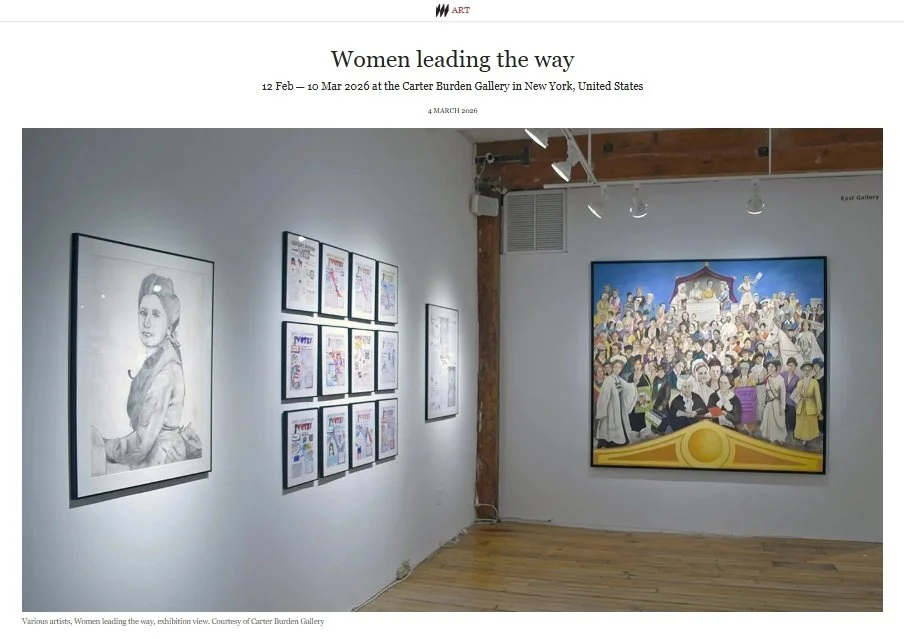
In conjunction with Women’s History Month, Carter Burden Gallery is pleased to present Women leading the way, a national student art and women’s history exhibition created by artist Mireille Miller on view from February 12 through March 10, 2026. The opening reception will take place on Thursday, February 12, from 6:00 to 8:00 PM. Press are invited to view the exhibition and interview contributing artists and student contributors pre-exhibit from 5pm-6pm. With the exhibition an intergenerational workshop will be held at Carter Burden Gallery on Saturday, February 28 from 2:00 to 4:00 PM, led by performing artist and printmaker Barbara Lubliner (as Ms. Muscle).
Developed in collaboration with Lycée Français de New York and EmmEmm Publishing, the exhibition brings together art, women’s history, and storytelling to celebrate the enduring legacy of the Women’s Suffrage Movement through the voices of young artists from across the United States.
“This exhibit represents more than a milestone in voting history; it is a testament to the human right to dream and take action," says Mireille Miller, artist and art teacher at Lycée Français de New York, "By exploring this history through art, students connect to a legacy that stretches across generations to figures like Elizabeth Cady Stanton, Harriet Tubman, and members of their own families."
Women leading the way features student-created portraits and personal essays that explore the struggle for women’s right to vote while forging deeply personal connections to family history. Students were invited to reflect on the question, “Who was the first woman in your family to vote?”, a prompt that transforms historical inquiry into an intimate act of remembrance and discovery. The resulting works form a powerful mosaic of perspectives that honor the past while encouraging reflection on civic engagement and participation today.
In keeping with Carter Burden Gallery’s mission to serve older adults through the arts, the exhibition also incorporates interviews with older adults reflecting on their own experiences with voting and those of their families. These intergenerational narratives deepen the historical context of the project and create a meaningful dialogue between generations, underscoring the lived impact of suffrage and civic participation across time.
By combining visual art, written narratives, and oral histories, the exhibition underscores the relevance of suffrage history to contemporary life and highlights the role of education, memory, and creativity in fostering civic awareness. Women Leading the Way affirms the importance of amplifying both emerging and elder voices, preserving personal histories that might otherwise be lost, and inspiring ongoing civic engagement.